Henry R. Vaillancourt MD MPH FAAFP
  • Home
  • About
    • Contact
  • Services
    • Presentations
    • Newsletters
    • Consulting
  • Blog
  • Lectures Access
  • Hot Topic Videos
Picture

Public Health Consulting & Educational Services

Henry R. Vaillancourt MD MPH FAAFP

everything you need to know about covid-19 testing: part II

5/29/2020

0 Comments


You might ask, “Why shouldn’t everyone have an antibody test, and if mine is positive, does that mean I am now immune?”
Well, the answer is not so simple but likely is closer to “not really.” A positive test does not give anyone a green light to stop all normal health precautions. Here’s why.
First, you need to understand a few key terms in order to see some of the problems associated with antibody tests:
  1. Sensitivity. This describes the degree of likelihood that a test will pick up the disease in someone who has it (or in this case, has had it). We also refer to this as the true positive rate. A highly sensitive test will pick up more of the people who have the disease than a less sensitive test.
  2. Specificity. This describes the degree of likelihood that someone who has not had the disease will test negative for it. A highly specific test will identify a greater number of people who have not had the disease. We view this number as the “true negative rate.” From a patient’s perspective, this is important since you don’t want to be labeled as having a disease that you don’t really have.
  3. Prevalence. This describes the percentage of the population that has or had a disease. In other words, how common is it in the community?

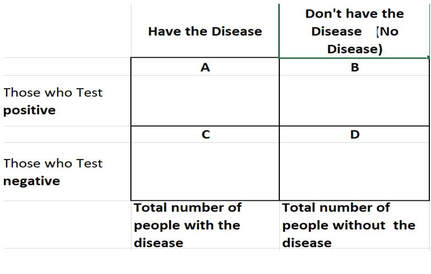
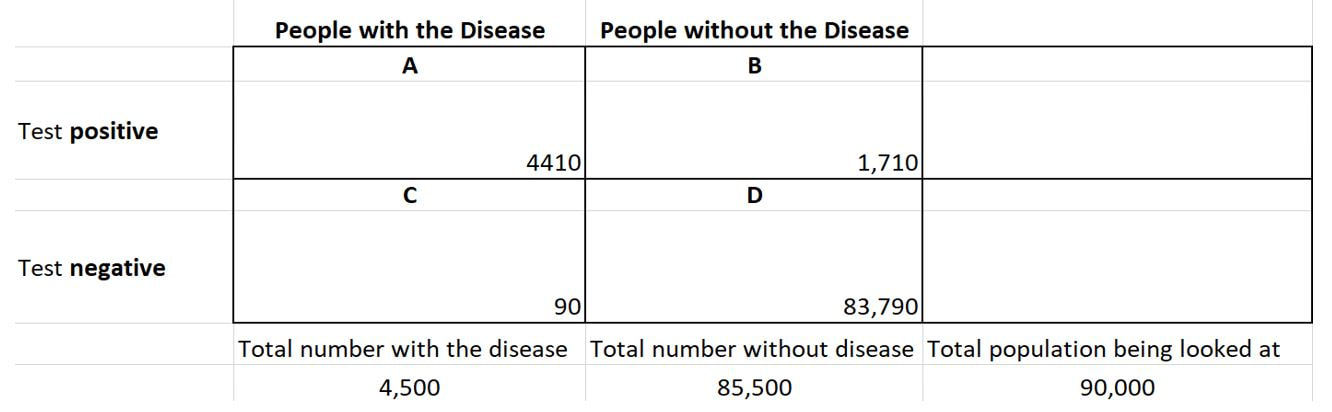
​Let’s look at how these three factors interact, and why there can be problems when widespread antibody testing is used for seeing who is “immune” rather than trying to get an idea of how prevalent a disease such as COVID-19 is in the community. Let’s look below at the “2x2 table” (an essential tool in epidemiology).

The top row (labeled “Those who Test positive”) contains the boxes showing the number of people who have a positive test result. It consists of Boxes A and B. The second row (labeled ‘Those who Test negative”) contains the boxes showing the number of people who have a negative test result. It consists of Boxes C and D.
 
If a test is highly sensitive, such as a 98% sensitivity, then that 98% of the people with the disease being tested for will have a positive test (and 2% will have a falsely negative test, i.e., they will be missed). If the same test has a specificity of 98%, then 98% of the people being tested who don’t have the disease will have a negative test result (and 2% will have a falsely positive test result, i.e., they will be labeled as having the disease when they do not).
​
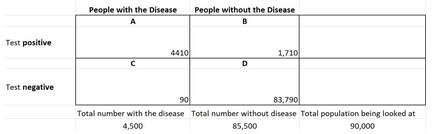
What now complicates this picture is the prevalence of the disease we are testing for. This is how many, or what percentage of the population is infected or has been infected. If 5% of the population has been infected, and, using a city of ~90,000 people as an example, then 4,500 people have or have had the disease (5% prevalence times the total population of 90,000). This is the number under Box C (“Total number with the disease”). Conversely, 85,500 people have not had the disease (the total population of 90,000 people, minus 4,500th [i.e., the number of people who have or have had the disease] gives this figure). This is the number under Box D, (“Total number without disease”) the sum of the column “People without the Disease” – in this case 85,500.
Boxes A, B, C and D total 90,000 (4,500 plus 85,500), which is the population of the city.

So, a test that is 98%, sensitive will correctly identify 98% of the people who have or have had the disease. In the case of our city, that would be ~4,410 people (98% times the total number of people with the disease (4,500) =4,410). This is the number in Box A which we refer to as “true positives.” The remainder of the 4,500, or 90 are in Box C. They tested falsely negative.

Now, the math becomes a little more complicated, because if the test is 98% specific (specificity) then 98% of the population who have not had the disease will have a truly negative test result (98% times the total number of people without disease or 85,500= 83,790). This is the number in Box D. We refer to this as the “true negatives.” The remainder of the 85,500 people who have not had the disease (85,500-83,790 =1,710) are in Box B. Although they have never had the disease, they will have a falsely positive test result. This is because the test was only 98% specific. It only gave a true negative result for 98% of those tested who have never had the disease! In other words, 2% of those people without the disease will have a “false positive” test result while 98% will have a true negative test result. This reveals an antibody test’s limitations.

​You can see that 6,120 people have a positive test result (determined by adding Boxes A and B together).
Let us suppose you don’t know whether you may or may not have had a COVID-19 infection. Currently, upwards of 30-40% of people with it may have had minimal to no symptoms (although recently that number has been postulated to be as high as 80%). If you get an antibody test that is both 98% sensitive and 98% specific and the test result is “positive,” then mathematically, there is only a 72% chance that your test was a true positive. Referring to the 2x2 table, Box A contains the number of “true positives” (people who have or have had the disease), and Box B contains the number of “false positives” (people who have never had the disease but whose test result is “positive.”) The total number of people whose test results were positive is the sum of Boxes A and B.  The ratio of “true positives” to all the positive test results comes out to 72% (4410/6120). We call this the “positive predictive value or PPV” of a test. This is a number that answers this question: “What is the likelihood that a positive test means I have or have had the condition?” In this case there is only a 72% chance your positive test is really positive, or conversely, a 28% chance that your positive test is actually a “false positive.”

If the prevalence of COVID-19 disease in a community is 3% rather than 5%, then a positive antibody test has a positive predictive value of 60% -- meaning that there is only a 60% chance of your result being a “true positive” and a 40% chance it is a “false positive.” So, you can see how important it is to know how prevalent the disease that you are screening for really is. The lower the prevalence, the higher the likelihood that even a good test will have “false positive” results. Note that a test with both a 98% sensitivity and 98% specificity is a really good test! Quite a few of the SARS-CoV-19 antibody tests reviewed by the FDA do not have those parameters.

If you have risk factors for a serious SARS-CoV-2 infection, would you rest comfortably on a test result that has a 25% or a 40% chance of being falsely positive rather than truly positive? Would you stop social distancing, frequent handwashing, wearing a mask, etc., based on the possibility that you really may not have had the disease after all?

Even if the test result you received was a “true positive” result. Does that mean you are immune? The present best answer is “We really don’t know.” Does the presence of antibodies convey immunity, or merely indicates you had COVID-19 and recovered? Studies have shown that upwards of 10-20% of symptomatically infected people have had little to no detectable antibody – yet they recovered.

How long does immunity last? If we look at SARS and MERS, measurable antibody levels persist for one to two years. But these diseases are not the same as COVID-19 and clearly we have learned that they do not behave the same. There are just too many questions for which we do not have the answers. Up until now, we have just looked at the tip of the iceberg and count cases on the basis of hospitalizations, or people being sick enough to seek medical care and be tested with a diagnostic test.
​
Some conclusions
  1. Since we really don’t know the true prevalence of SARS-CoV-2 in the United States, nor in most states and cities, the usefulness of a positive test for determining immunity is too low to be used as a reason to stop any of our safety present measures.
  1. The usefulness of antibody tests lies in giving us an answer as to what proportion of the population has been exposed to the virus.
  2. Antibody testing is not the panacea we originally thought it to be. To get adequate “herd immunity” (see a previous blog discussion) we will need to have a vaccine that is safe and effective.
  3. A crucial question still to answer is what exactly constitutes immunity and for how long
Picture
Picture
Picture
Picture
Picture
Picture
0 Comments

Your comment will be posted after it is approved.


Leave a Reply.

    Archives

    February 2021
    January 2021
    December 2020
    September 2020
    May 2020
    April 2020
    March 2020
    February 2020
    January 2020
    December 2019
    November 2019
    August 2019
    June 2019
    April 2019
    March 2019

    Categories

    All

Henry R. Vaillancourt MD MPH FAAFP

Copyright ©2018

  • Home
  • About
    • Contact
  • Services
    • Presentations
    • Newsletters
    • Consulting
  • Blog
  • Lectures Access
  • Hot Topic Videos